
INSIGHTS
Ideas worth thinking about
ECONOMICS OF EVERYDAY LIFE
What economics can teach us about the choices we make, the value we assign, and the lives we build.
Comparative Advantage: You Don't Have to Be the Best

There is a rather exhausting belief that we have to be good at everything.
Good at our jobs.
Good with people.
Good with money.
Good at managing our time.
Good at leading.
Good at technology.
Good at keeping up.
And if we are entrepreneurs?
Apparently, we are also expected to be good at marketing, sales, finance, operations, design, technology, strategy, administration and whatever else the business decides to throw at us before breakfast.
No wonder we’re tired.
Economics offers a rather liberating idea: you don’t have to be the best at everything.
You need to understand where your resources create the most value.
That is where comparative advantage comes in.
Better isn’t the same as best
Comparative advantage is often confused with being the best at something.
It isn’t.
In economics, comparative advantage is about being relatively better at producing something when you consider what you give up to do it — your opportunity cost.
And that distinction matters.
Imagine two people who can both write and design.
One may be better at both.
But if writing costs that person very little in terms of what they have to give up, while design costs them a great deal of time and effort, their comparative advantage may still be in writing.
Meanwhile, the second person may be relatively better suited to design because their opportunity cost of doing it is lower.
So the question isn’t simply:
“What am I good at?”
It is:
“Where do I create the most value relative to what else I could be doing?”
That is a much more relevant question.
Think about your working life.
You may be perfectly capable of doing many things.
But capability is not the same as value.
You might be able to write the proposal, manage the accounts, prepare the presentation, organise the event, analyse the numbers, create the social media content and fix the printer.
That doesn’t mean you should.
Every hour you spend doing one thing is an hour you cannot spend doing another.
And that brings us back to opportunity cost.
Your time is scarce.
Your energy is scarce.
Your attention is scarce.
So when you use them, the real question isn’t simply whether you can do something.
It is whether your resources are being used where they create the greatest value.
That can change how we think about work.
Sometimes the most valuable thing you can do is not become better at something.
It is to stop doing it yourself.
The trap of “I can do it”
This is particularly relevant when you start a business.
In the beginning, you do everything because you have to.
You answer the emails.
You make the slides.
You chase the invoices.
You write the copy.
You organise the logistics.
You fix the website.
And because you can do all these things, it is tempting to keep doing them.

But somewhere along the way, “I can do it” becomes a poor substitute for “I should be doing it.”
The more your business grows, the more expensive that distinction becomes.
If someone else can do a task adequately while you could spend that same time doing something only you can do particularly well, doing everything yourself may actually be the less productive choice.
This isn’t laziness.
It is allocation.
And that is one of the reasons comparative advantage matters far beyond economics.
You don’t have to be the best
There is something else I like about this idea.
Comparative advantage takes some of the pressure out of the obsession with being the best.
You don’t necessarily need to be the best speaker in the room.
You don’t need to be the best strategist, writer, salesperson, designer or analyst.
You need to understand where your particular combination of experience, capability, perspective and resources creates disproportionate value.
That is a very different proposition.
It also means someone else’s strength does not automatically diminish yours.
Someone can be better than you at something and still not be the person who should be doing it.
And you can be less skilled than someone else at a particular task while still being the person whose time is better spent on it.
Because value is contextual.
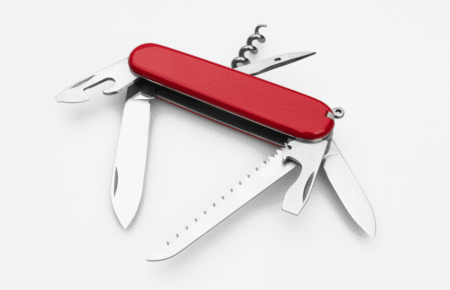
A Swiss Army knife is useful precisely because it can do many things.
But that doesn’t make it the best tool for every job.
Sometimes the right tool is the one designed for that particular task.
And sometimes the right person is the same.
There is a leadership lesson here too.
Comparative advantage has implications for leadership.
A leader who insists on doing everything may look capable.
But a leader who understands where different people create the most value can build something much stronger.
That means knowing your own comparative advantage.
It also means recognising someone else’s.
Instead of asking:
“Who is the best person?”
we should sometimes ask:
“Who is best placed for this?”
Those sound almost identical.
They aren’t.
The first creates competition.
The second creates allocation.
And when people are placed where their capabilities can create the greatest value, the whole system can become more productive.
That is not about putting people into boxes.
It is about understanding that people have different combinations of skills, experience, preferences, resources and opportunity costs.
Good leadership doesn’t require everyone to be equally good at everything.
It requires knowing who is best used where — and giving them the space to contribute.
Also…
Comparative advantage doesn’t mean only do what you’re already good at.
That would turn it into an excuse for staying comfortable.
Sometimes we deliberately develop a skill because it will create greater value later.
Sometimes we learn something because we need enough understanding to make good decisions, even if we never become the expert.
And sometimes we choose to do something simply because we value it.
Economic efficiency isn’t the only thing that matters in a human life.
That’s important.
Because the goal isn’t to optimise every minute of our existence.
The goal is to make intentional choices about where our limited resources go.

And sometimes the most valuable use of your time isn’t the thing that produces the highest financial return.
It might be the conversation with your child.
The hour spent learning.
The rest you desperately need.
The relationship you are building.
The work that matters to you.
Value depends on what you value.
So, where are you best used?
That’s the question comparative advantage leaves us with.
Not:
What am I good at?
Not even:
What am I passionate about?
But:
Where does my time, energy and capability create the greatest value — for me and for others?
The companion question is even harder:
What am I doing simply because I can, when someone or something else could do it better — or when my resources could be creating greater value elsewhere?
You don’t have to be the best.
You don’t have to do everything.
You don’t even have to prove that you can.
Sometimes the smartest thing you can do is recognise where you are most valuable — and stop spending your scarce resources trying to be everything else.
Because knowing your value is one thing.
Knowing where to put it is another.
– Insights by Norra Ismail
Looking for a Speaker?
A good talk should give people something to think about – and, ideally, something worth taking with them afterwards.

Think clearly.
Live meaningfully.
Grow with purpose.
Was this post helpful?
If you found this post helpful and you think it can help someone else, please share it.
It takes time to come up with meaningful content. If you appreciate the content and would like to help me rebuild my life after a profound loss, please consider making a contribution.

Leave a comment